GOOGLE CORAL Edge Tpu Coprocessor Raspberry Pi Embedded 608614201389 Usb Accelerator
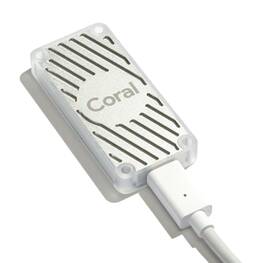
( Brand: Google Coral ), ( Manufacturer Part Number: CORAL-USB-ACCELERATOR ), ( UPC: 608614201389 )
Review GOOGLE CORAL Usb Edge Tpu Ml Accelerator Coprocessor Raspberry Pi And Other Embedded
The Google Coral USB Edge TPU Accelerator Coprocessor for Raspberry Pi is a revolutionary add-on designed to accelerate machine learning inference at the edge. This compact device, model number 608614201389, is specifically engineered to work seamlessly with the Raspberry Pi, providing an ideal solution for developers and hobbyists looking to bring advanced machine learning capabilities to their embedded projects.
The USB Edge TPU Accelerator is equipped with Google's custom-built Tensor Processing Units (TPUs). These TPUs are designed to deliver high-performance machine learning inference at the edge, enabling real-time object detection and other advanced computer vision applications. The accelerator is capable of running popular machine learning models like MobileNet, SSD-Mobilenet, and Tensorflow Lite with ease.
The device is connected to the host Raspberry Pi via a USB 3.0 interface, making it simple to set up and use. It supports both C and Python APIs, allowing developers to write custom code and integrate the accelerator into their projects. Furthermore, it comes with pre-installed software, including TensorFlow Lite, making it easy to get started with machine learning inference right out of the box.
The USB Edge TPU Accelerator is designed with a small form factor, making it an ideal choice for space-constrained embedded projects. It features a low power consumption design, enabling long battery life or reduced power consumption in larger projects. The device also comes with a mounting bracket, making it easy to securely attach it to the Raspberry Pi or other surfaces.
In summary, the Google Coral USB Edge TPU Accelerator Coprocessor for Raspberry Pi is a powerful and versatile solution for developers and hobbyists looking to add advanced machine learning capabilities to their embedded projects. Its small form factor, low power consumption, and ease of use make it an ideal choice for a wide range of applications, from robotics to computer vision and beyond.
The Google Coral USB Edge TPU Accelerator is a coprocessor designed to run TensorFlow Lite models on the edge for inference tasks. Here are some pros and cons of buying this device for use with a Raspberry Pi:
Pros:1. Fast Inference: The Edge TPU is specifically designed for machine learning inference, and it can process models much faster than the Raspberry Pi's CPU or GPU. This makes it ideal for real-time applications that require quick responses.
2. Power Efficient: The Edge TPU is designed to be power-efficient, which is important for battery-powered or low-power applications.
3. Easy to Use: The Coral Dev Board is a complete development kit that includes the Edge TPU, Raspberry Pi Compute Module, and other necessary components. It also comes with pre-compiled TensorFlow Lite models and example code.
4. Expandable: The Edge TPU can be used with other Coral devices, such as the Coral Dev Board and the Coral USB Accelerator, to create more complex machine learning systems.
5. Community Support: Google provides extensive documentation and community support for the Coral line of products.
Cons:1. Cost: The Coral USB Edge TPU Accelerator is more expensive than the Raspberry Pi's CPU or GPU alone. This may be a barrier for some users.
2. Limited Connectivity: The Edge TPU has limited connectivity options, with only USB 2.0 and UART available. This may limit its use in certain applications.
3. Compatibility: The Edge TPU is only compatible with certain TensorFlow Lite models. Users may need to retrain their models or find pre-compiled models that are compatible.
4. Size: The Coral Dev Board is larger than a standard Raspberry Pi, which may make it less portable.
In conclusion, the Google Coral USB Edge TPU Accelerator can be a valuable addition to a Raspberry Pi setup for real-time machine learning applications that require quick responses and low power consumption. However, its higher cost, limited connectivity, and compatibility issues may be a barrier for some users. Ultimately, the decision to purchase the Edge TPU depends on the specific requirements of the project.
If the project requires fast inference, low power consumption, and real-time responses, then the Coral USB Edge TPU Accelerator is a worthwhile investment. However, if the project has limited resources or compatibility is a concern, then it may be better to stick with the Raspberry Pi's built-in CPU or GPU for machine learning tasks.
Details:
Fully supports Mobile Net and Inception architectures through custom are possible. Model's are developed in TensorFlow Lite and then compiled to run on the USB Accelerator. This allows fast ML conferencing to embedded AI devices in a power-efficient and privacy-preserving way. Full supports Mobile Net and Inception architectures through custom are possible.
Features: Google Edge TPU ML acceleration coprocessor, USB 3.0 Type-C female, supports Debian Linux to host CPU, model's are built with TensorFlow Supports Mobile Net and Inception architectures through custom possible. Included cable is USB Type-C to Type-A.: Coral USB Accelerator brings powerful ML machine learning conferencing capabilities to existing Linux systems. Fully supports Mobile Net and Inception architectures though custom are possible Compatible with Google Cloud.
Features: Google Edge TPU ML accelerator coprocessor, USB 3.0 Type-C socket, Supports Debian Linux on host CPU, model's are built using TensorFlow. Coral, a division of Google, helps build intelligent ideas with platform for local AI. However, this will not affect the shipping times. Brand New USB Edge TPU ML Accelerator coprocessor for Raspberry Pi and Other Embedded Single Board Computers, Manufacturer model: Coral-USB-Accelerator Specifications: Arm 32-bit Cortex-M0 microprocessor MCU: up to 32 MHz max 16 KB flash memory with ECC 2 RAM connections: 3.1 Gen 1 port cable Super Speed, 5Gb/s transfer speed.
Edge TPU key benefits: High speed TensorFlow Lite conferencing Low power Small footprint.
specifications casefahea:
- brand: Google Coral
- mpn: Coral-usb-accelerator
- upc: 608614201389
general casefahea:
- condition: New
- Computer Components Parts > Fans, Heat Sinks Cooling > Computer Case Fans
returns casefahea:
- time: 30 Days
- policy: Returns Accepted
- paid by: Seller
- method: Money back
payments casefahea:
- other
- wallet: Paypal
- credit card: Visa
shipping casefahea:
- transit: 4-6 Days
- service: Standard
- class: Standard
- type: Fixed
- cost: $0.00
offer casefahea:
- started: February 27, 2026
- options: Ship-to-home
- sold: 0
- availability: In Stock
seller casefahea:
- # reviews: 53203
- rating: 100.0%
- city: Within USA